
Social listening systems tend to fail quietly in Arabic.
Not because data is missing, but because meaning is misunderstood.
Sentiment shifts are subtle. Irony is common. Context is political, cultural, and often implicit. Most tools trained on English-first models reduce Arabic to keywords, volume, or translated sentiment labels. What they capture is activity. What they miss is intent.
Al Kindi AI was built to close that gap.
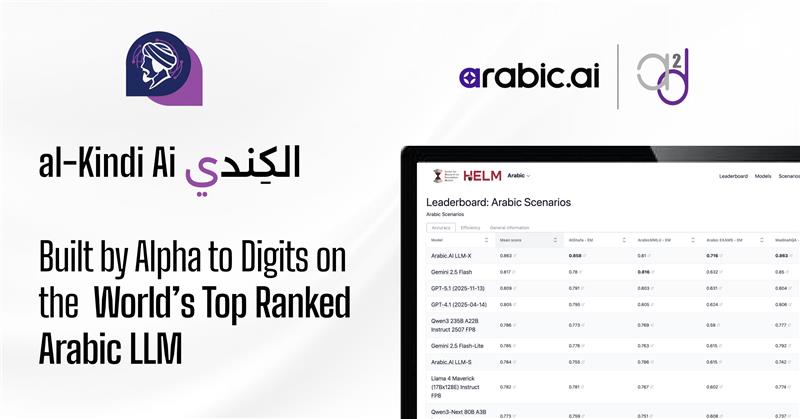
Built by Alpha to Digits, Al Kindi AI is an Arabic-first social listening and intelligence platform designed to analyze public discourse, detect sentiment shifts, and surface real signals across Arabic digital ecosystems. Its foundation is LLM-X by Arabic.AI, the Arabic-first large language model ranked #1 on Arabic benchmarks in the Stanford HELM evaluation.
This foundation is not a technical footnote. It defines what the system can and cannot understand.
Why social listening breaks in Arabic
Most social listening platforms were designed for languages where sentiment is explicit and structure is linear. Arabic does not behave this way.
Meaning in Arabic often lives between the lines. Praise can signal dissatisfaction. Humor can mask criticism. A phrase that appears neutral can carry strong sentiment depending on dialect, timing, or audience. When models treat Arabic as translated English, they flatten this complexity.
The result is misleading dashboards. Apparent trends that do not hold up under scrutiny. Missed signals that matter most to institutions.
This is why Arabic social listening cannot rely on surface-level classification. It requires native reasoning.
Sentiment is not enough anymore
One of the biggest misconceptions in social listening is that sentiment alone explains public perception.
In Arabic discourse, sentiment is often secondary to narrative. People may express approval while signaling concern, or express frustration while reinforcing loyalty. Understanding these dynamics requires more than polarity scores.
What matters is how narratives evolve, which language patterns repeat, and where shifts in tone indicate emerging pressure points. This is where most tools fall short, and where Arabic-first intelligence becomes essential.
The role of the foundation model
Social listening is only as strong as the model interpreting the data.
LLM-X was built with Arabic as a primary reasoning language, not as an afterthought. It was trained on years of curated Arabic data spanning Modern Standard Arabic, dialectal usage, and institutional language from government, media, and enterprise environments.
This depth allows LLM-X to interpret discourse beyond classification. It can distinguish tone from intent. It can understand why a topic trends, not just that it does.
This capability is what earned LLM-X its top ranking on Stanford HELM’s Arabic evaluations. More importantly, it is what makes it suitable for real social intelligence.
Al Kindi AI as an intelligence system, not a monitoring tool
Al Kindi AI is not built to count mentions or track hashtags.
Alpha to Digits designed it as an intelligence layer that sits above Arabic digital discourse. It ingests large volumes of social data, but its value comes from how that data is interpreted, contextualized, and surfaced for decision-makers.
Because it is powered by LLM-X, Al Kindi AI can detect emerging narratives, identify sentiment inflection points, and analyze public response with linguistic and cultural awareness. This moves social listening from reporting into strategic insight.
In environments where public sentiment influences policy, reputation, or trust, this distinction is critical.
From listening to understanding
The most important shift in social listening today is moving from observation to comprehension.
Volume does not explain motivation. Sentiment does not explain direction. What organizations need is understanding. Why people are reacting. What language signals escalation. Where discourse is heading before it becomes visible at scale.
This is where Arabic-first intelligence changes the equation.
By building Al Kindi AI on LLM-X, Alpha to Digits ensured that social signals are interpreted through a model that understands Arabic as it is used, not as it is translated.
A broader lesson for Arabic AI
Al Kindi AI highlights a broader truth about Arabic AI systems.
When intelligence products are built on generic foundations, they inherit generic blind spots. When they are built on native models, they unlock depth, reliability, and trust.
Social listening is one of the clearest examples of this. It exposes how quickly shallow language understanding leads to false confidence. It also shows how powerful Arabic-first reasoning can be when applied correctly.
The debate the ecosystem should have is not about tooling. It is about foundations.
Do we want systems that observe Arabic discourse, or systems that actually understand it?
Building for what comes next
Arabic digital spaces are growing in influence, speed, and complexity. Institutions can no longer rely on translated intelligence to navigate them.
Al Kindi AI demonstrates what becomes possible when applied social intelligence is built on a model designed for Arabic from the ground up.
Strong products start with strong models.
Insight starts with understanding.
Arabic AI deserves both.
