Prepping for the Agentic Era: Part 1: Understanding AI Agents Beyond Chatbots
The rapid advancement of AI technologies has introduced a variety of powerful tools, among which AI agents stand out as autonomous systems capable of executing complex workflows with minimal human intervention. Unlike chatbots or simple automation, AI agents perceive context, plan actions, and continuously learn, making them invaluable digital collaborators in business environments.
We will explore what defines an AI agent, contrasts them with chatbots and automation flows, and demonstrates how to design and deploy them effectively, using marketing workflows as a practical example. It also delves into essential technical considerations, including workflow design, tooling choices, and emerging intelligence paradigms such as RAG, CAG, and KAG. By understanding these concepts, professionals can better harness AI agents to drive innovation and growth.
What is an AI Agent?
AI agents represent a significant evolution in artificial intelligence systems, operating as autonomous software entities capable of performing complex tasks on behalf of users or organizations. Unlike traditional AI models that follow a simple input-response paradigm, AI agents exhibit advanced cognitive abilities: they perceive their environment, plan multi-step actions, execute these through integration with diverse tools or APIs, and learn from each interaction to improve future performance.
At their core, AI agents function as intelligent digital collaborators, not merely passive assistants. They possess memory systems that retain context across interactions, enabling them to manage extended workflows and make decisions informed by accumulated knowledge. This memory can take several forms: short-term active context windows, long-term semantic vector databases for deep recall, episodic event logs, or stable profile databases containing user or system-specific facts.
Another defining characteristic is their use of reasoning and planning layers. These layers allow AI agents to interpret high-level goals and decompose them into actionable subtasks, sequencing steps logically while responding dynamically to changing inputs or outcomes. This distinguishes AI agents from basic automation flows which typically execute static, linear sequences without adaptability.
For example, an AI agent assigned to manage marketing content creation might autonomously gather trending topics, generate outlines, draft social media posts, schedule publishing, and monitor engagement, all while adjusting strategy based on real-time campaign data.
Technical architectures supporting AI agents often combine large language models (LLMs) for understanding and generation, with retrieval augmented generation (RAG) or chain-augmented generation (CAG) modules to ground outputs in trustworthy data, plus orchestrators that manage tool invocation, error handling, and iterated refinement. These capabilities enable agents to operate effectively even in complex enterprise environments.
AI agents can be implemented via specialized frameworks such as LangChain or LlamaIndex, or custom-built using Python and orchestration layers. Selection of frameworks and design patterns depends on project scale, complexity, security requirements, and integration needs.
In summary, AI agents differ fundamentally from simple AI assistants or chatbots in autonomy, complexity, reasoning ability, and integration breadth. They are poised to become essential workforce collaborators accelerating productivity and innovation across industries.
How AI Agents Differ from Chatbots and Automation Flows
Understanding the distinction between AI agents, chatbots, and traditional automation flows is crucial for businesses when selecting the right technology for their use cases. Despite some overlap in underlying AI technology, their architectures, capabilities, and purposes diverge significantly.
Architecture and Technology
- Chatbots are often built on rule-based engines or basic natural language processing systems with intent classification and keyword matching. Most chatbots lack persistent memory beyond a single user session and follow predefined scripts or decision trees. They provide reactive, immediate responses but have limited ability to adapt or learn autonomously.
- Automation flows execute fixed sequences of tasks, typically configured via workflow automation platforms (e.g., Zapier). They handle repetitive, structured tasks but lack context awareness, reasoning, or the ability to interact dynamically.
- AI agents combine large language models, continuous contextual memory, and reasoning modules. These agents maintain session continuity and long-term memory, dynamically plan multi-step actions, and integrate deeply with enterprise tools and APIs to complete complex goals autonomously.
Capabilities and Functionality
- Chatbots excel at handling simple, repetitive queries like FAQs, booking appointments, or guided form entries. Their scope is limited to scripted dialogues and they cannot operate beyond their explicit programming.
- Automation flows perform tasks like sending emails, updating databases, or syncing data but lack any form of proactive decision-making or learning.
- AI agents operate at a higher level, capable of breaking complex goals into subtasks, prioritizing work, escalating exceptions, and learning from interactions. They can operate across platforms, combining information, interacting with APIs, and adapting dynamically.
Real-World Comparison
Consider a customer support scenario:
- A chatbot responds to “What is my order status?” using scripted data lookup.
- An automation flow sends a follow-up email after a purchase.
- An AI agent identifies unhappy customers by sentiment analysis, escalates urgent tickets, coordinates with logistics APIs to expedite shipping, and drafts personalized responses without human intervention.
Scope of Knowledge and Learning
- Chatbots are limited to preset knowledge bases and require manual updates for new content.
- AI agents synthesize information live, access multiple data sources, and improve autonomously over time through feedback loops and reinforcement learning.
Summary Table
| Dimension | Chatbots | Automation Flows | AI Agents |
|---|---|---|---|
| Autonomy | Reactive, script-bound | Fixed sequence execution | Goal-directed, planning, and decision-making |
| Memory | Limited (session only) | Static during workflow | Persistent, evolving, multi-session |
| Task Complexity | Simple queries | Repetitive, structured tasks | Complex, multi-step workflows |
| Learning | Manual updates | None | Continuous, adaptive learning |
| Integration | Limited to predefined interfaces | Defined API triggers | Deep tool and API orchestration |
| Use Case Examples | FAQ answering | Email drip campaigns | End-to-end customer support and engagement |
These distinctions make AI agents far more suited to today’s complex business environments where proactive, adaptive workflows and data-driven decisions are essential.
Building an AI Agent for Marketing: The SEO Scout Agent
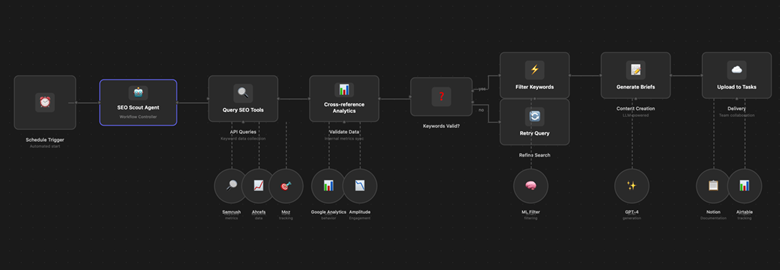
AI agents offer transformative potential for marketing teams by automating critical yet time-consuming workflows. One powerful example is the SEO Scout Agent, designed to continuously monitor and optimize content strategy through data-driven insights.
Goal and Scope
The primary goal of the SEO Scout Agent is to identify promising keywords weekly, generate detailed content briefs based on the latest SEO trends and user behavior, and seamlessly push these briefs to content teams for execution. Automating this approach ensures content remains competitive, relevant, and aligned with business objectives without manual overhead.
Architectural Overview
The SEO Scout Agent architecture typically comprises:
- Data Connectors: Interfaces to SEO tools like Semrush, Ahrefs, or Moz to extract current keyword metrics, search volume, ranking difficulty, and competitor data.
- Analytics Cross-Reference: Synchronization with internal analytics platforms such as Google Analytics or Amplitude to validate keyword performance against actual site user behavior and engagement.
- Processing & Filtering Module: Advanced filtering layers that remove duplicates, competing keywords, or irrelevant terms using rule-based and machine learning models.
- Content Brief Generator: A natural language generation component, potentially powered by large language models, that creates detailed briefs including keyword focus, topical outlines, meta descriptions, and suggested internal linking strategies.
- Task Management Integration: Automated uploading of briefs to tools like Notion, Airtable, or Jira for easy team collaboration and tracking.
Workflow Details
- Query SEO tools: The agent runs scheduled API queries to gather fresh keyword data, incorporating multiple dimensions such as trending queries, competitor gaps, and seasonal shifts.
- Cross-reference Analytics: Collected keyword data is validated and enriched with internal web traffic and conversion metrics, ensuring focus on high-impact opportunities.
- Filter Keywords: The system removes noise and redundant entries using customizable criteria refined by ongoing learning and feedback.
- Generate Content Briefs: Using SEO best practices and brand guidelines, the agent auto-creates briefs that serve as clear action plans for content creators.
- Upload to Task Management: Briefs are systematically organized and assigned within project management platforms, ensuring smooth transition from insight to execution.
Technical Implementation Considerations
- APIs & Data Quality: Reliable API access and clean, structured data are foundational. Proper error handling, rate limiting, and data refresh scheduling ensure robust operation.
- Model Customization: Fine-tuning generation models on company-specific style, voice, and SEO priorities enhance brief relevance and usability.
- Automation Overlays: Incorporate human-in-the-loop checkpoints for critical content approval, balancing automation speed with quality control.
- Scalability: Architecting modular components enables scaling across multiple content verticals or international markets, with localized keyword strategies.
Strategic Benefits
- Continuous Optimization: SEO strategies remain adaptive and data-driven rather than reactive, maximizing search visibility and organic traffic growth.
- Resource Efficiency: Frees marketers from routine keyword research and briefing, allowing more time for creative strategy and stakeholder engagement.
- Integration Synergy: Seamlessly fits within existing marketing tech stacks, amplifying tool investment ROI and cross-team collaboration.
CLI Agents vs Visual Builders: Pros and Cons
When developing AI agents, one must decide the most appropriate method to design, configure, and deploy these autonomous systems. Two dominant approaches have emerged in industry practice: Command-Line Interface (CLI) agents and Visual Builders. Understanding the strengths and trade-offs of each is crucial to selecting a solution that meets both technical requirements and business needs.
CLI Agents
CLI agents provide developers with direct, granular control over all aspects of an AI agent’s behavior through scripting or configuration files. This approach is favored in complex, enterprise-grade applications requiring fine-tuned logic and seamless integration.
- Advantages: Flexibility, Scalability, Transparency, Compatibility
- Disadvantages: Technical Barrier, Longer Development Time, Maintenance Complexity
Visual Builders
Visual agents leverage drag-and-drop interfaces, flowcharts, and templates to construct AI workflows graphically. They are designed to empower business users, marketers, and analysts without deep programming skills.
- Advantages: Accessibility, Speed, Collaboration, Lower Cost
- Disadvantages: Limited Customization, Vendor Lock-in, Performance Overheads
Decision Matrix
| Aspect | CLI Agents | Visual Builders |
|---|---|---|
| Technical Expertise | High (developers) | Low to moderate (business users) |
| Flexibility | Extensive | Limited to prebuilt modules |
| Speed of Deployment | Slower, development-heavy | Faster, prototyping-focused |
| Ideal Users | Developers, technical teams | Marketing, product teams |
| Maintenance | Code-based, version controlled | GUI-based, potentially vendor dependent |
Hybrid Models and Future Trends
Modern AI platforms increasingly support hybrid approaches, combining the best of both worlds. For instance, business users might design core flows visually, while developers extend capabilities through scripting hooks or custom plugins. Additionally, low-code/no-code solutions continue evolving with AI-powered recommendations and auto-generation features, further bridging gaps.
What is JSON? Other Formats for Agent Design
Defining AI agent workflows and configurations requires structured data formats that are both machine-readable and human-editable. JSON (JavaScript Object Notation) is the most prevalent format because of its simplicity, readability, and compatibility with almost all programming languages and systems.
Alternatives to JSON
Alternatives include YAML, XML, and Domain-Specific Languages (DSLs). The choice depends on project scope, team skills, tooling, and preferences.
RAG, CAG, and KAG: Enhancing AI Agent Intelligence
Modern AI agents derive significant power from techniques that enable them to ground their outputs in reliable data sources, reason across multiple information hops, and leverage structured knowledge. Three key paradigms have emerged: Retrieval-Augmented Generation (RAG), Chain-Augmented Generation (CAG), and Knowledge-Augmented Generation (KAG).
Each method improves agent accuracy, trustworthiness, and domain expertise in specific ways, and they are often combined for best results.
Conclusion
AI agents represent a transformative advance in AI capabilities, shifting from scripted automation to autonomous, context-aware collaborators. They enable continuous learning, dynamic planning, and complex multi-step automation, redefining efficiency and innovation in business workflows.
By understanding these systems, their architectures, development approaches, and advanced intelligence models, organizations can strategically adopt and harness AI agents to gain lasting competitive advantages in 2025 and beyond.