For years we have been told the AI race is about who builds the biggest model, who holds the most GPUs, and who reaches the frontier first. That is part of the story. It is not the important part.
On 12 September, Dario Amodei published We Must Pace the Frontier, arguing that the industry should deliberately slow the rate at which model capabilities improve so that alignment and safety work can keep up. He put forward three steps: permanent embedded third-party evaluators, coordination among frontier companies in democratic countries, and eventual global coordination. He committed Anthropic unilaterally to the first. Demis Hassabis endorsed the direction within hours. OpenAI followed.
Notice what the first step actually is. It is not a research breakthrough, a compute cap, or a treaty. It is an evaluation commitment: give independent people permanent, employee-level access, so that claims about a system can be checked by someone other than the people who built it.
That is the sentence I want the region to sit with. The frontier’s own answer to “we are moving too fast” is not to build less. It is to measure more, in the open, by parties who do not benefit from the result.
Sovereignty, properly understood, is the same argument applied to a different geography. It is not isolation, and it is not slowing down. It is the capability to evaluate, audit, adapt and, if necessary, refuse, on your own terms, in your own language, on your own soil.
The rest of this piece is about why Arabic makes that capability a technical requirement rather than a political preference. Every number below is public and reproducible.
1. The representation gap is not a talking point. It is a data distribution.
Arabic is a first language for more than 400 million people. In June 2026, W3Techs measured Arabic at 0.6% of websites whose content language it could identify, against 49.7% for English.
Website share is a crude proxy for a language’s online life. It undercounts messaging, voice, video comments, closed platforms and the enormous volume of Arabic that never becomes an indexed page. But crude as it is, it is close to the distribution that general-purpose models are trained on. When the pretraining corpus is the public web, a language at 0.6% is not a priority. It is a rounding error that the model learns to approximate.
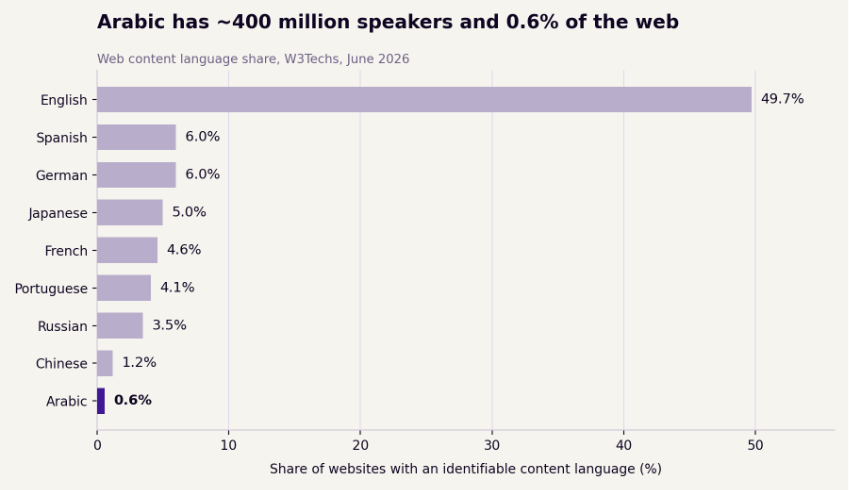
Figure 1. Share of websites by content language. Source: W3Techs, June 2026.
This is the first thing “Arabic support” obscures. Coverage of a script is not competence in a language.
2. Before a model reasons about Arabic, it has to break it apart
Arabic is morphologically rich. Meaning lives in roots, patterns, clitics and optional diacritics, not in English-style word order. A short particle can invert a clause. A missing mark can change the word.
Tokenizers built for English handle that structure badly, and the cost is measurable. On an identical 39-million-word Arabic corpus, LLaMA 2’s tokenizer produces 5.38 tokens per Arabic word and preserves just 1.8% of Arabic words as whole tokens. An Arabic-adapted tokenizer on the same corpus reaches 1.71 tokens per word and 63.23% word integrity. It encodes the corpus in 66.55 million tokens instead of 210.03 million, a reduction of roughly 68%.
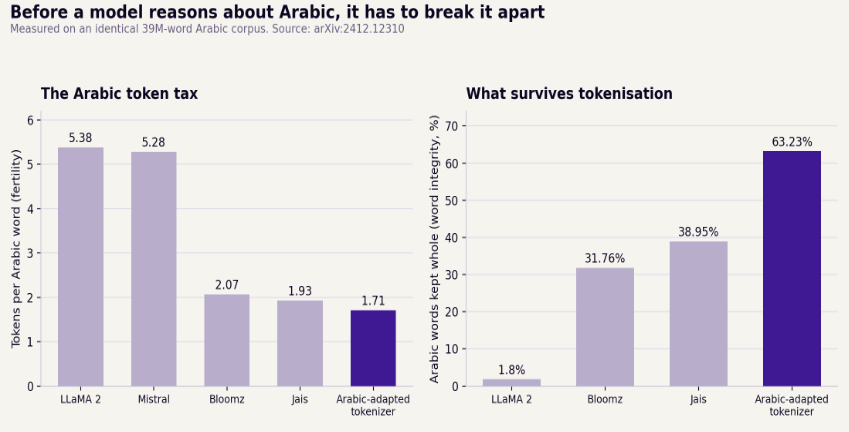
Figure 2. Tokenizer fertility and Arabic word integrity, measured on an identical 39M-word corpus. Source: arXiv:2412.12310.
Two consequences follow, and enterprises feel both.
The first is cost and context. Roughly three times the tokens for the same Arabic text means three times the inference spend, three times the memory pressure, and a context window that holds a third as much of your actual document.
The second is subtler and worse. In recent cross-lingual work, model-native tokenizers fragment Arabic at about 2.4 tokens per word against 1.5–1.6 for English, and that fragmentation tracks sharper performance degradation as inputs get longer and more complex. A system that looks fine on a short prompt is not the same system when you hand it a 40-page contract.
3. The gap is structural, not an allocation bug
The obvious objection is that this is a vocabulary budget problem. Give Arabic a fairer share of the token vocabulary and it goes away.
It does not. Researchers tested exactly this using a debiased multilingual tokenizer with vocabulary allocated fairly across languages. Per-language fertility ratios all clustered near 1.0, confirming allocation was fair. The fragmentation persisted anyway: Arabic showed token–morpheme coherence of 0.10 against English’s 0.42, and 89% of Arabic tokens carried no semantic content, against 58% for English.
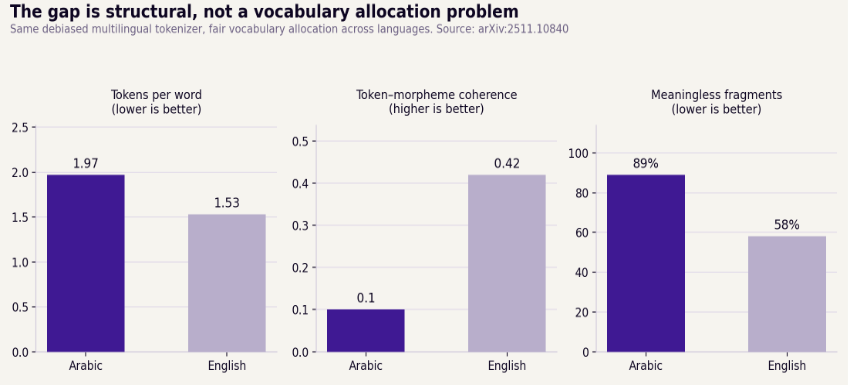
Figure 3. Arabic vs English under a debiased multilingual tokenizer with fair vocabulary allocation. Source: arXiv:2511.10840.
In plain terms: even when you are generous with the vocabulary, token boundaries land in the wrong places in Arabic, because Arabic’s morphology does not sit where an English-shaped algorithm looks for it. Radar fragments into prefix, middle and suffix. Inspect breaks across a morpheme boundary into pieces that mean nothing.
You cannot fix that with a bigger model. You fix it by building for the language from the representation layer up, which is an engineering programme, a data programme and a talent programme, not a licensing decision.
4. What the benchmarks actually show
In May 2026, Stanford’s Center for Research on Foundation Models published HELM Arabic Enterprise, a leaderboard evaluating models on six Arabic enterprise tasks: article generation, three financial reasoning settings, and UAE legal question answering in open-book and closed-book form. Every prompt, response, metric and score is logged and reproducible through the open-source HELM framework. Arabic.AI collaborated on the benchmark; the results are Stanford’s and are published in full, which means anyone who doubts them can rerun them.
Here is the finding that should reset the regional conversation. This chart shows the best score achieved by any model evaluated, not ours and not anyone’s in particular. The ceiling of the field.
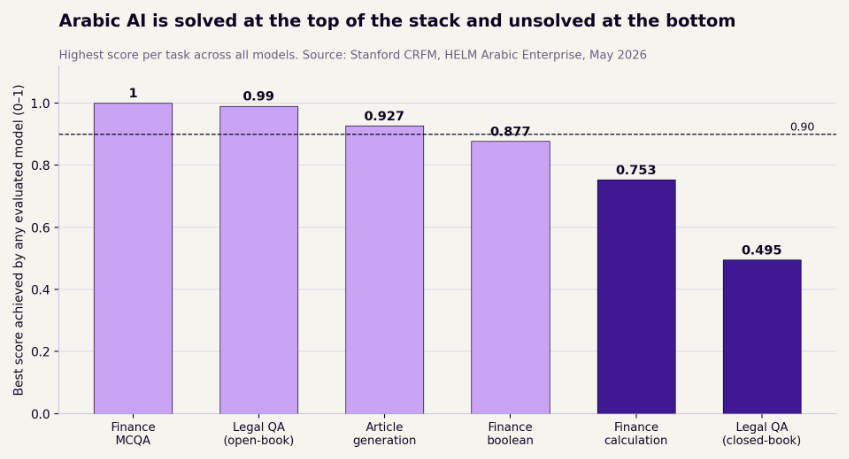
Figure 4. Highest score achieved by any model, per task. Source: Stanford CRFM, HELM Arabic Enterprise, May 2026.
Arabic multiple-choice finance is effectively saturated: a perfect 1.00. Open-book legal QA reaches 0.99. Corporate article generation reaches 0.927.
Then the floor drops. Financial calculation tops out at 0.753. Arithmetic without tools remains unreliable, and in finance a small numerical error is not a small error. Closed-book UAE legal QA tops out at 0.495. That is the best result achieved by any model in the evaluation. On UAE law, without a statute in the prompt, the state of the art is roughly a coin flip.
Note also what the article-generation score conceals. Stanford graded generation on three separate axes (faithfulness, completeness and style adherence) precisely because fluent Arabic and correct Arabic are different achievements. Even at a top score of 0.927, many models inserted facts that were not in the source material. Fluency is not reliability. A confident answer can still be wrong in a way that matters legally or operationally.
5. What the system is handed matters more than how smart it is
Put the two legal settings side by side and the sovereignty argument stops being rhetorical.
Same models. Same questions, written by Arabic legal experts. The only difference is whether the relevant statute is in the prompt. With it: 0.99. Without it: 0.495. Performance halves.
The same shape appears in finance. Recognising the right financial concept in multiple choice: 1.00. Computing the answer: 0.753.
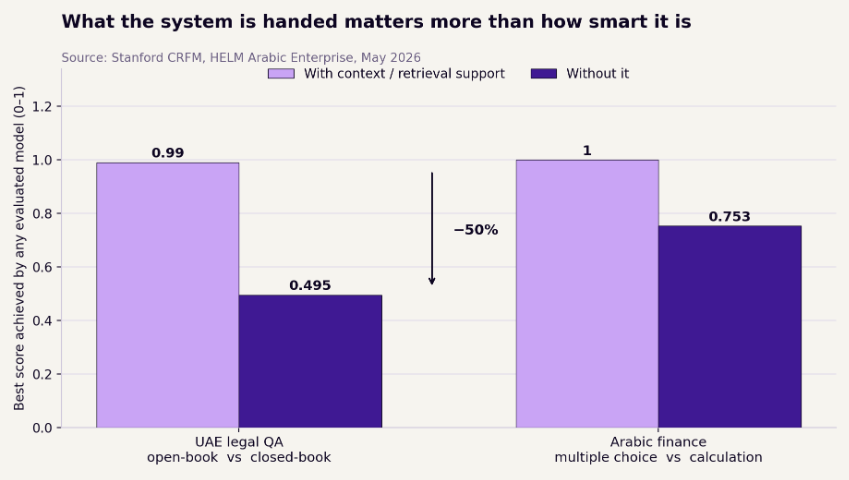
Figure 5. The effect of context and tooling on the same tasks. Source: Stanford CRFM, HELM Arabic Enterprise, May 2026.
This is the most operationally important result on the board, and it points somewhere specific. The gap between 0.495 and 0.99 is not closed by a smarter model. It is closed by retrieval that works on your documents: your statutes, your circulars, your scanned Arabic PDFs, your tables, your layouts. The intelligence in that pipeline is not concentrated in the model. It is distributed across the ingestion, the retrieval, the grounding and the boundary the system is allowed to operate inside.
Which is why “we use the best model” is not an AI strategy, and why “where the server sits” is not sovereignty. If your retrieval, your speech stack and your document understanding were built for English web text, they will fail on the documents your institutions actually run on, and they will fail quietly, which is the dangerous way to fail.
6. Why open evaluation is the load-bearing part
One more detail from the HELM Arabic record deserves more attention than it has had.
Version 1.0.0 of the general HELM Arabic leaderboard shipped with a bug: context was being omitted when models were evaluated on context-based question answering in two of the seven benchmarks. It was found, documented in public pull requests, corrected in version 2.0.0, and disclosed in a dated erratum on the original post, which now carries a notice telling readers that its published figures refer to the superseded version.
That is not an embarrassment. That is the entire case.
A closed benchmark cannot do that. A vendor-run benchmark has no incentive to do that. A leaderboard that publishes every prompt and response, versions its releases, and corrects itself in public is doing for Arabic evaluation exactly what Amodei is asking third-party evaluators to do for frontier labs: making claims checkable by people who did not make them.
You cannot audit what you cannot measure. You cannot explain an answer you cannot ground. You cannot halt a system you do not control. Independent evaluation, in our languages and on our own infrastructure, is a scientific requirement, not a political extra.
7. What this means for the region
The Middle East has capital, infrastructure being built at unusual speed, governments willing to move, and one of the world’s largest language communities. None of that converts into agency on its own. Agency is a capability, and the numbers above say where the capability has to be built.
Not in a race to train the largest model. In five layers that the leaderboards have now made legible:
- Representation. Arabic-first tokenisation and modelling, because the fragmentation problem is structural and compounds with document length.
- Retrieval and documents. The single largest measured performance lever in the benchmark, a 2× swing, sits here rather than in model scale.
- Domain knowledge. A 0.495 ceiling on closed-book UAE legal QA is a statement about what no model currently knows. Somebody has to build that, and it will not be built elsewhere.
- Evaluation. Open, versioned, in-language, reproducible, and willing to publish its own errata.
- Engineers in the room. Every layer above is an operating model, not a procurement line item.
Sovereignty does not mean choosing between global AI and local AI. We should use the best models in the world, partner with the best labs, benchmark ourselves against the frontier, and bring the best technology into the region. But partnership is strongest between equals, and equality requires capability.
The frontier labs are now saying out loud that capability is outrunning control, and that the remedy begins with independent measurement. The Arabic-language evidence says the same thing in a different register: what we cannot measure in our own language, we cannot govern in our own institutions.
That is what sovereignty means. Not slowing down. Making sure that when the world accelerates, we can still see what is happening, and say no.
Sources
- Dario Amodei, We Must Pace the Frontier, darioamodei.com, 12 September 2026.
- Stanford CRFM, HELM Arabic Enterprise, 26 May 2026. crfm.stanford.edu/helm/arabic-enterprise/latest/
- Stanford CRFM, HELM Arabic, 18 December 2025, with erratum dated 3 June 2026. crfm.stanford.edu/helm/arabic/latest/
- W3Techs, content language usage statistics, June 2026.
- Second Language (Arabic) Acquisition of LLMs via Progressive Vocabulary Expansion, arXiv:2412.12310. Tokenizer fertility, word integrity, corpus token counts.
- Tracing Multilingual Representations in LLMs with Cross-Layer Transcoders, arXiv:2511.10840. Token-morpheme coherence, meaningless fragment rates.
- Cross-Lingual Empirical Evaluation of Large Language Models for Arabic Medical Tasks, arXiv:2602.05374. Model-native tokenizer fragmentation, Arabic vs English.