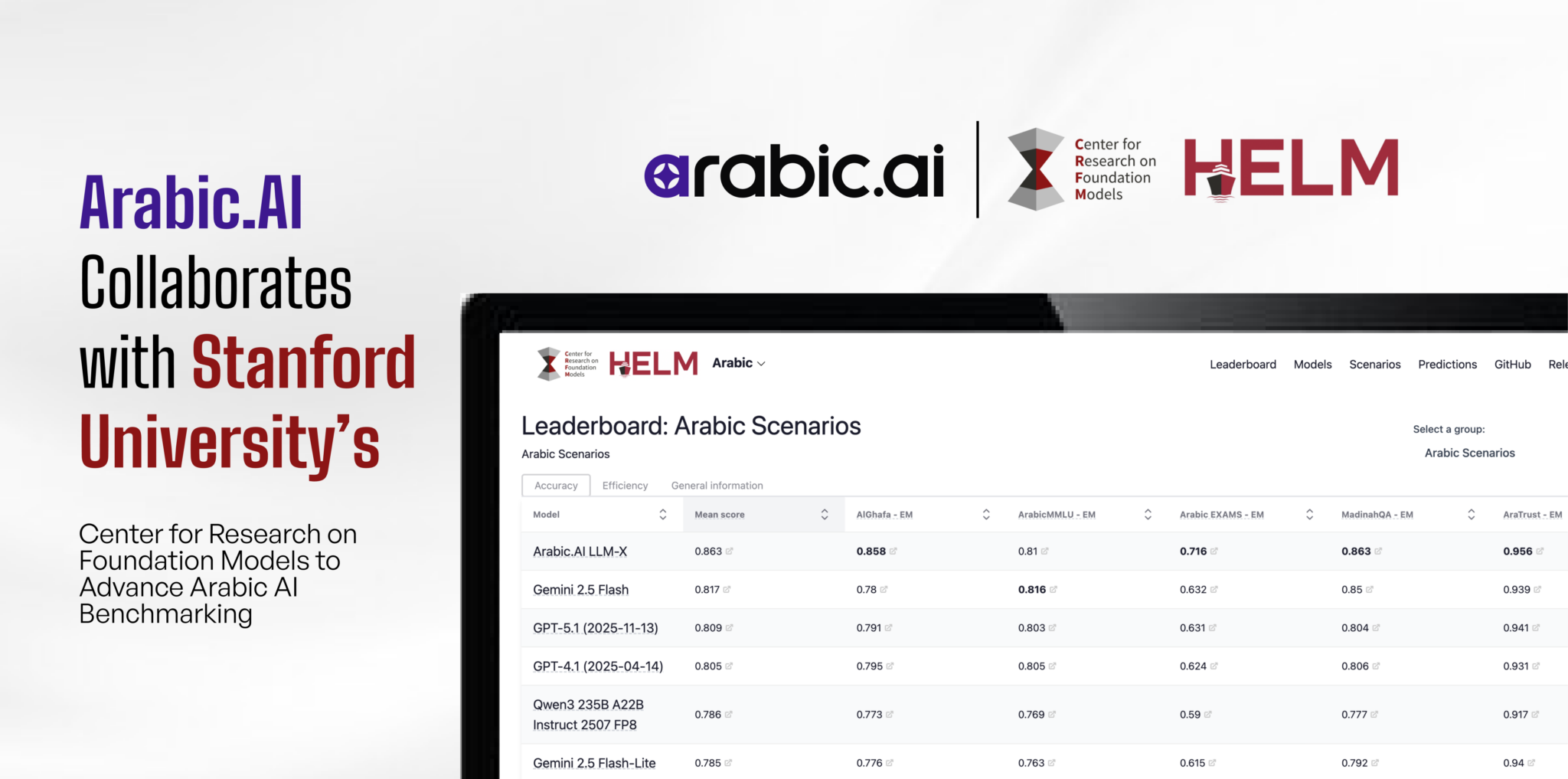
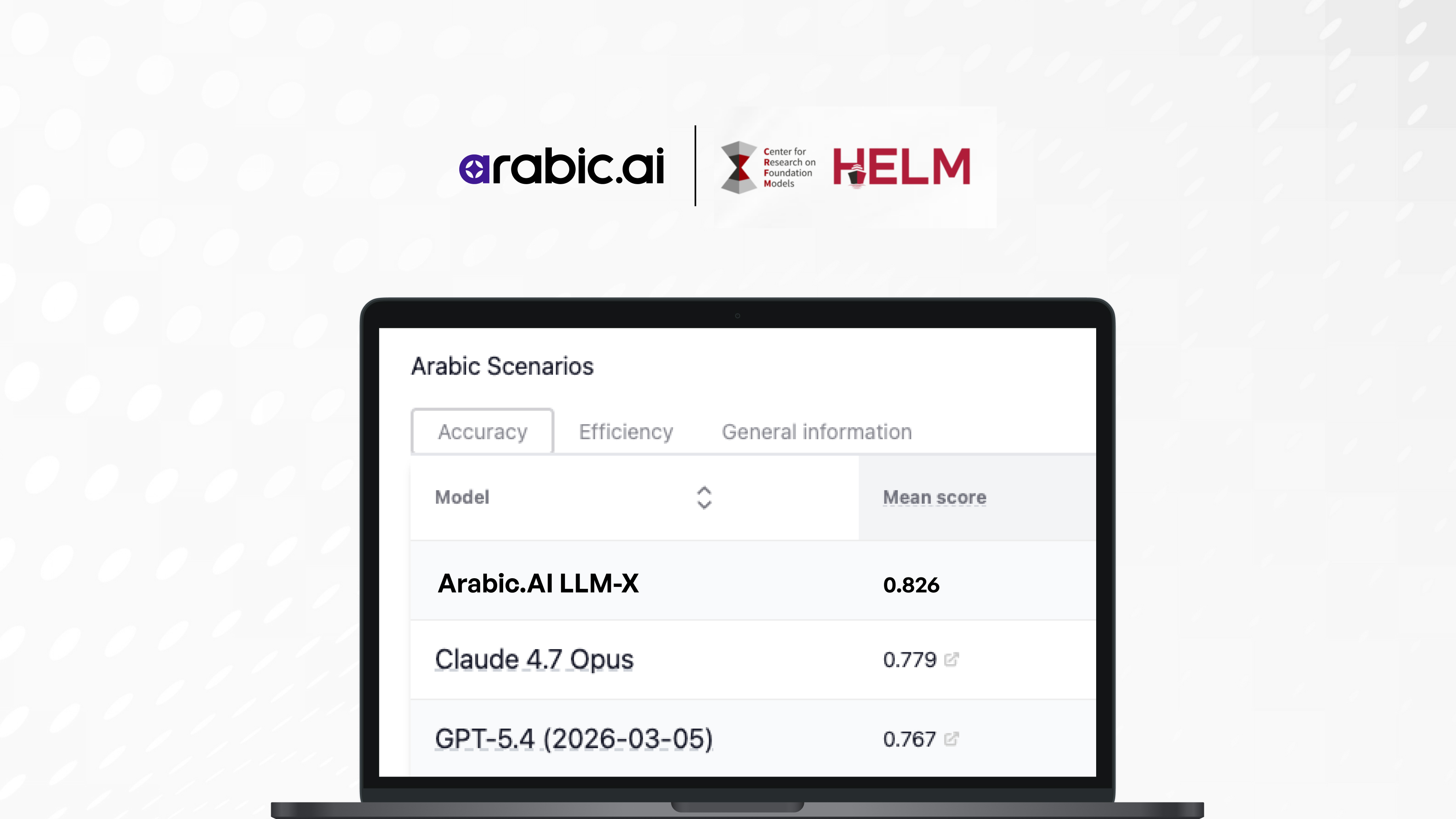
announced a strategic investment and partnership with Arabic.ai.





Contents
The illusion of AI sovereigntyEurope’s wake-up callGovernments cannot build this future aloneTalent is the real strategic assetInfrastructure, research, and the economics of ownershipThe Gulf’s opportunityInvesting today is a national security imperativeThe question is who will own the futureArtificial intelligence is becoming a pillar of national power. The question is no longer who uses AI most effectively, but who controls the capabilities that will shape its future.
For decades, nations measured their strength through territory, energy, industrial capacity, and military power. In the digital age, another dimension of national power is emerging: the ability to develop, control, and advance artificial intelligence.
This shift carries a profound strategic implication. A country can invest billions in AI, deploy the most advanced applications, and transform its public services while remaining dependent on technologies it does not control.
It can purchase access to intelligence without owning the capacity to produce it.
And that distinction may ultimately determine the difference between countries that shape the next global economy and those that must adapt to decisions made elsewhere.
The illusion of AI sovereignty
Across the world, governments are announcing ambitious AI strategies, establishing national AI initiatives, investing in data centres, and signing agreements with global technology companies. These investments are important. Access to the world’s best technologies will remain essential, and no country needs to develop every component of the AI stack independently.
But access and ownership are not the same.
A government may host its data locally while depending on foreign models. It may operate its own infrastructure while relying on external software, chips, technical expertise, and updates. It may deploy thousands of AI agents while lacking the engineers capable of improving the underlying systems when its needs change.
Where, then, does sovereignty begin?
It begins with the ability to make strategic choices without being entirely dependent on the permission, priorities, pricing, or continued availability of an external provider.
If the intelligence underpinning a nation’s government, healthcare, energy, financial services, defense, and critical infrastructure is developed and controlled elsewhere, the country may benefit enormously from AI adoption. Yet its ability to shape that technology remains limited.
The issue is not whether foreign technology is good or bad. Global partnerships are indispensable. The issue is whether a nation retains meaningful alternatives, develops domestic capabilities, and possesses the expertise to understand and influence the systems on which it increasingly depends.
In an AI-driven world, dependency can become a structural vulnerability.
Sovereignty is much more than a model
One of the most common misconceptions about AI sovereignty is that it can be achieved by building a national language model.
A model is important, but it is only one layer of a much larger technological system.
Real AI capability rests on an interconnected stack: research and scientific knowledge, advanced talent, computing infrastructure, data, models, engineering tools, deployment platforms, security, and the applications that translate intelligence into economic and strategic value.
These layers reinforce one another.
Research produces new capabilities. Talent turns discoveries into working systems. Infrastructure makes those systems trainable and affordable to operate. Startups transform them into products. Customers generate revenue, feedback, and real-world data that support further development. Capital finances the next generation of research and companies.
Remove enough of these layers, and the system becomes dependent on capabilities developed elsewhere.
Owning a model without the talent to improve it is insufficient. Owning infrastructure without the software and engineering expertise to use it competitively is insufficient. Training researchers without creating companies capable of employing them is insufficient. Even owning the entire technical stack on paper means little if it cannot compete economically or deliver measurable results.
AI sovereignty is not a procurement decision. It is an industrial capability.
Europe’s wake-up call
Europe illustrates the consequences of confusing technological excellence with technological control.
The continent has world-class universities, scientific institutions, engineering talent, and industrial expertise. Yet these strengths did not automatically translate into leadership across the commercial AI ecosystem as generative AI accelerated.
The emergence of Mistral AI demonstrated both the gap and the opportunity. Founded in 2023, the French company became a prominent European contender in advanced AI, showing that Europe could translate its scientific and engineering talent into a company capable of competing internationally.
But Mistral is not simply a story about building a better model. Its development also highlights the importance of investment, computing capacity, commercial partnerships, and the ability to scale research into infrastructure and products. Its own European AI strategy has called for coordinated action to attract talent, expand infrastructure, mobilise private investment, and help homegrown companies scale.
The lesson is not that Europe lacked intelligence or scientific potential. It is that research excellence alone does not guarantee industrial leadership.
A region can educate exceptional researchers and still lose them to companies elsewhere. It can produce important scientific breakthroughs while the commercial value is captured by others. It can regulate a technology without possessing the companies and infrastructure required to shape its evolution.
Europe’s challenge is therefore not merely to invent more. It is to convert knowledge into enduring industrial capacity.
For the Gulf, this lesson should be considered before dependency becomes deeply embedded in the economy.
There is an opportunity to learn from Europe’s experience rather than repeat it: build the ecosystem while demand, capital, and strategic ambition are aligned.
Governments cannot build this future alone
Governments have an indispensable role in national AI development. They can provide strategic direction, invest in infrastructure, support education and research, establish trusted regulatory frameworks, and create demand through public procurement.
They can also help solve one of AI’s most difficult economic problems: the enormous upfront cost of computing, research, and talent before a company has achieved commercial scale.
But governments are not substitutes for an entrepreneurial ecosystem.
AI advances through continuous experimentation. Companies must test new architectures, adapt models to specific industries and languages, develop deployment tools, solve security problems, and discover business models that customers are willing to pay for. Many experiments will fail. Others will produce capabilities that were not anticipated when the original strategy was written.
That is precisely why a functioning startup ecosystem matters.
Startups can move quickly, take technical risks, specialise in underserved markets, and turn research into products. They can develop the layers that large technology providers do not prioritise. They can compete to solve difficult problems in Arabic, healthcare, financial services, energy, government, and other strategically important sectors.
Universities contribute research and talent. Governments provide direction, enabling infrastructure, and early demand. Established companies contribute industrial expertise and distribution. Investors provide risk capital. Startups connect these elements through innovation and execution.
No single participant can replace the others.
The objective should not be for governments to become the sole builders of AI. It should be for governments to create the conditions in which globally competitive AI companies can emerge, scale, and remain anchored to the region.
This requires more than grants and incubators. It requires sustained R&D funding, access to computing resources, pathways from university research to commercial products, patient growth capital, competitive procurement, and the willingness to let companies experiment and compete.
It also requires governments to become demanding customers: buying measurable outcomes, not simply announcing partnerships.
A national AI strategy that funds infrastructure but neglects the companies that will use it risks building expensive capacity without a sustainable innovation engine. A strategy that attracts international providers but does not develop domestic expertise may accelerate adoption while leaving the underlying dependency intact.
The goal must be to build an ecosystem that produces technology, not merely consumes it.
Talent is the real strategic asset
Infrastructure can be purchased. Computing capacity can be contracted. Models can be licensed or adapted.
Deep technical talent is harder to acquire, and an experienced research and engineering ecosystem takes years to develop.
The competition for AI talent is therefore not simply a recruitment challenge. It is a competition for the ability to innovate continuously.
A country needs researchers who understand the science, engineers who can build reliable systems, infrastructure specialists who can optimise computing costs, product teams that understand real users, and entrepreneurs who can turn technical advances into viable businesses.
It also needs environments where these people can work together, challenge existing assumptions, conduct ambitious research, and build companies with global reach.
If the best talent is trained locally but must leave to pursue frontier research, the country is effectively subsidising someone else’s technological advantage. If skilled professionals are recruited but have no access to meaningful R&D, advanced computing, or ambitious commercial opportunities, retaining them will be difficult.
Talent policy must therefore extend beyond education and recruitment. It must include research opportunities, competitive funding, access to infrastructure, strong universities, international collaboration, and companies capable of offering challenging work at scale.
The ultimate measure of success is not how many people have completed an AI course. It is how many people can build, improve, and commercialise the next generation of AI systems.
Infrastructure, research, and the economics of ownership
AI is also an industrial undertaking with substantial physical requirements.
Computing chips, data centres, energy, networking, storage, and reliable access to computing capacity all affect a country’s ability to develop and deploy advanced systems. Control over infrastructure does not automatically create sovereignty, but dependence on infrastructure that is scarce, expensive, or externally controlled can constrain it.
The answer is not necessarily to build every data centre or purchase every chip independently. Such an approach could be economically inefficient, particularly for smaller markets.
Instead, governments and businesses must decide which capabilities are strategically essential to control, which can be secured through diversified partnerships, and which can be shared across the region.
The same discipline must apply to research and development.
R&D cannot be treated as a temporary expense that is justified only when it produces immediate commercial returns. In AI, sustained research is what allows companies to improve model performance, reduce inference costs, address local requirements, strengthen security, and develop differentiated products.
Without it, a company can become little more than a distribution channel for technology developed elsewhere.
The strategic question is not whether every country should build a frontier model from scratch. It is whether each country, or a regional ecosystem acting collectively, possesses sufficient technical depth to adapt, evaluate, secure, and advance the systems it relies on.
That is a more practical definition of sovereignty: control over critical capabilities, combined with the freedom to collaborate internationally.
The Gulf’s opportunity
The Gulf has several assets that can support a different approach: long-term investment capacity, ambitious national development agendas, significant digital infrastructure projects, and governments that can create demand at scale.
But capital alone does not guarantee a technological ecosystem.
The region must convert investment into capabilities that compound over time. That means funding research alongside deployment, backing startups alongside major infrastructure projects, and building pathways through which regional companies can become international technology leaders.
It also means recognising that Arabic AI is not simply a translation problem.
Arabic-speaking societies have distinct linguistic, cultural, institutional, and operational requirements. Building AI that serves these requirements effectively involves data, evaluation, domain expertise, engineering, and continuous research. These capabilities cannot be secured permanently through a licence alone.
The Gulf has an opportunity to develop a regional ecosystem in which countries collaborate on research, computing, talent development, and shared standards while supporting competitive companies that specialise in different layers of the AI stack.
One country may lead in computing infrastructure; another may develop specialised research capabilities; regional startups may build models, platforms, and applications for public and private sectors across multiple markets.
The aim should not be technological isolation. It should be strategic interdependence among capable partners, rather than dependence on a single external source.
Such an ecosystem would create value beyond the immediate performance of AI applications. It would retain more intellectual property, develop highly skilled jobs, deepen research capabilities, strengthen regional supply chains, and create companies that can export technology to the rest of the world.
That is how AI investment becomes industrial development.
Investing today is a national security imperative
National security in the AI era cannot be defined solely by protecting data or securing access to software.
It must also include the capacity to understand the technology on which critical institutions depend, assess its vulnerabilities, develop alternatives, and maintain essential services if external conditions change.
This does not mean that every foreign provider represents a threat, or that domestic technology is automatically safer. Security depends on architecture, governance, testing, resilience, and accountability, regardless of where a system originates.
But meaningful choice requires real capabilities.
A nation that has invested in its own research, engineering talent, infrastructure, and technology companies has more options when markets change, supply becomes constrained, commercial priorities shift, or geopolitical relationships are tested.
A nation that has invested only in access may find that its options are narrower precisely when it needs them most.
The returns on building an AI ecosystem will not always be visible in the next quarter or the next fiscal year. Some research will fail. Some startups will not survive. Some infrastructure investments will take years to pay off.
That is the nature of building strategic capacity.
The relevant question is not whether every investment will succeed. It is whether the long-term cost of remaining dependent could be far greater than the cost of developing the ability to choose.
The question is who will own the future
The AI race should not be reduced to a contest over who can announce the largest investment, launch the most powerful model, or deploy the greatest number of applications.
The more consequential question is who will possess the capabilities to keep innovating when the technology changes.
Will we have the researchers who can advance it? The engineers who can build and secure it? The infrastructure that allows us to operate it? The companies that can commercialise it? The capital that enables those companies to scale? And the ecosystem that connects all these capabilities into a durable source of national strength?
These are the foundations of technological sovereignty.
The Gulf does not need to replicate Silicon Valley or reproduce the entire American or Chinese technology stack. It needs a strategy suited to its own economic strengths, languages, institutions, and security requirements — one that identifies the capabilities it must own, the partnerships it should pursue, and the companies it must enable to succeed.
The window to make these choices is now, while the global AI ecosystem is still evolving and the distribution of technological power is still being shaped.
Investing in the ability to build AI is not a luxury reserved for wealthy nations or a prestige project for governments. It is an investment in economic competitiveness, institutional resilience, and national security.
The nations that merely adopt AI will benefit from the intelligence others create. The nations that build the capacity to create it will have a greater say in how the future is designed.
In the AI era, the question is no longer simply who will use the technology.
It is who will own the capability to shape what comes next.